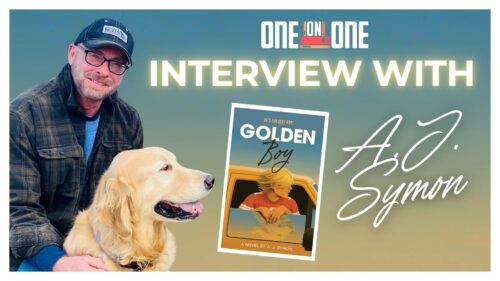
Join us as we chat with the debut author about his YA adventure novel inspired by his furry friend, Chip!
From their wagging tails to their sweet purrs, animals in media and literature are often the most beloved characters, and when we’re beside our favorite reading buddy, we often find ourselves wondering what our pets would say to us if they had the chance. In Golden Boy by debut author A.J. Symon, he gives readers and animal lovers alike the chance to see that question made reality when a young girl accidentally turns her beloved golden retriever into a human.
We had the opportunity to sit down with A.J. to dive into his new novel, exploring the enduring popularity of animal companions and all the things we wish we could say.
Congratulations on the upcoming release of your debut novel! You mentioned that you made the switch to a novelist at 60. What was it about Golden Boy that told you that this needed to be published, and how has the publishing process been for you?
Thank you. I’m so grateful to Simon & Schuster for seeing the potential in my manuscript. The process was amazing. Even though I’ve been writing for years, I am grateful to have learned so much working with everyone on the team.
The story behind Golden Boy is a bit sad, but it has a happy ending. In 2024, my golden retriever Chip, who was my service dog and best friend for ten years, got a very aggressive form of cancer. So aggressive that by the time he showed any symptoms, it was too late. He was diagnosed on Wednesday and gone on Thursday. And that broke me. All I could do was sit and read books and watch TV. But everything seemed so dark and cynical; it just made me feel worse.
At some point, I managed to get myself in front of the computer and start writing. This idea from years ago that I’d had about a dog who becomes a human football star came back to me, and I said to myself, I’m gonna write that story. It’s gonna be a book, and it’s gonna be a book for young people. No idea why. It just felt right.
Everything I felt about Chip came pouring out of the mouths and through the actions of my characters. First, it was mostly grief and sadness, but then I started remembering all the joy, and the lessons he taught me, and the ten years of unconditional love Chip gave me. And all that poured out into the book. I started feeling better. I realized how blessed I am to know such a sweet soul.
I worked furiously and had the first draft done in about two months. When I came up for air, I realized that I’d written the book I needed to read that whole time. It was like Chip’s spirit was still alive in the story. So I hope that through Golden Boy, his spirit continues to lift people up like he did for me all those years.
The bio on your author website says you have an M.F.A. in Screenwriting. How did you first become interested in screenwriting, and did it impact your drafting process for Golden Boy? Did you find it challenging not to accidentally slip into the structure of a script?
I’ve been a late bloomer all my life, and I spent most of my college years bouncing around from one major to another until I took a playwriting course and suddenly felt like I’d found my home. I’ve always loved characters and character-driven stories. I was a latchkey kid, so I spent hours and hours alone with my dog watching reruns every afternoon after school. Those old shows were all built around great characters. Plus, I’m from the South, which is full of colorful characters, too. All of that shaped the writer I’d become.
I loved creating characters of my own, especially writing dialogue, and I threw myself into it. Since TV was such a huge part of my formative years, screenwriting just seemed like a natural progression from playwriting. So I went to graduate school to learn the craft.
I think that my screenwriting background actually helped in terms of structuring and pacing Golden Boy. I like to keep things moving, and I like a lot of white space so that the page appears easy to read. There’s an old saw among screenwriters that no paragraph should be more than four lines long. Screenplays have lots of sentence fragments and one-sentence paragraphs—and single-word paragraphs—which makes it easy for a reader to breeze right through. I think that’s helpful when you’re writing a book for young people, too. So I applied all of that to Golden Boy. In fact, I credit my screenwriting background for being able to write the football sequences. They read a lot like an action sequence in a screenplay would.
